Free · No sign-up · Instant
Pea Gravel Calculator
Rectangles, circles, L-shapes, area or volume in feet or metres. Get cubic yards, tons, bag counts and cost, with a waste allowance built in.
Start here
How much pea gravel do I need?
Pea gravel, also sold as pea stone or pea shingle, is a rounded 3/8 inch (10 mm) aggregate. To work out how much you need, multiply the area you are covering by the depth you want, then convert to the units your supplier sells in. In square feet and inches that is:
Cubic feet = area (ft²) × depth (in) ÷ 12
Cubic yards = cubic feet ÷ 27
US tons = cubic yards × 1.35
Then add 10% for waste 25% if the gravel will be compacted, as on a driveway.
For most people the quickest answer is that one cubic yard covers 162 square feet at 2 inches deep, and weighs about 1.35 US tons. If you would rather not do any of this by hand, the calculator above has it covered.
| Project | Area | Depth | Cubic yards | Tons | Bags |
|---|---|---|---|---|---|
| Small patio | 10 x 10 ft | 2 in | 0.68 | 0.92 | 37 |
| Seating area | 12 x 12 ft | 3 in | 1.47 | 1.98 | 80 |
| Garden bed | 10 × 20 ft | 2 in | 1.36 | 1.83 | 74 |
| Walkway | 3 × 50 ft | 3 in | 1.53 | 2.06 | 83 |
| Large ground cover | 20 × 20 ft | 2 in | 2.72 | 3.67 | 147 |
| Driveway (25% allowance) | 12 × 24 ft | 4 in | 4.44 | 6.00 | 240 |
Reference
Pea gravel coverage chart in square feet per yard and ton
How far one cubic yard and one ton spreads at each depth.
| Depth | 1 cubic yard covers | 1 ton covers | Typical use |
|---|---|---|---|
| 1 inch | 324 ft² | 240 ft² | Topping up an existing bed |
| 2 inches | 162 ft² | 120 ft² | Ground cover, borders, beds |
| 3 inches | 108 ft² | 80 ft² | Walkways, patios, dog runs |
| 4 inches | 81 ft² | 60 ft² | Light driveways, drainage |
| 6 inches | 54 ft² | 40 ft² | Driveways, French drains |
At 100 lb per cubic foot a 50 lb bag holds almost exactly half a cubic foot the same as a bag sold by volume. That is why a cubic yard works out to 54 bags either way, and why you can compare bag prices directly without converting anything.
Depth
Recommended depth by project type
Too shallow and the base shows through. Too deep and it never feels firm underfoot.
| Project | Depth | Base required |
|---|---|---|
| Ground cover & garden beds | 2 in | Landscape fabric |
| Borders and edging strips | 2 in | Landscape fabric |
| Walkways and paths | 2–3 in | Fabric, firm edging |
| Patios and seating areas | 3 in | Compacted base recommended |
| Dog runs | 2–3 in | Fabric, drainage |
| Fire pit surrounds | 2–3 in | Fabric |
| Pool surrounds | 2–3 in | Fabric, firm edging |
| Driveways | 4–6 in | 4–6 in compacted crushed stone |
| French drains | Fill trench | Geotextile wrap |
| Playground fall zones | 9–12 in | Per CPSC guidance |
Driveways need a base, not just more gravel
Pea gravel is rounded and water-worn, so the stones roll over each other instead of locking together the way crushed stone does. Poured straight onto soil it will rut under tyres within a season. Build 4–6 inches of compacted crushed stone first, then 2–3 inches of pea gravel on top, and edge it firmly.
Playground depths are a safety standard, not a preference
The US Consumer Product Safety Commission treats pea gravel as an acceptable playground surfacing material, but only at depth around 9 inches uncompressed for equipment with a fall height up to about 5 feet, and more for taller equipment. This is one case where you should follow the published guidance rather than the look you want.
CPSC guidance sets loose-fill depth by equipment fall height, and accounts for compaction: an initial fill of about 12 inches settles to roughly the 9 inches of maintained depth the guidance calls for.
French drains are measured by trench, not by area
For a drain you are filling a trench, so switch the calculator to Volume mode, or use Rectangle mode with the trench length and width and the fill depth. A 50 ft trench 12 in wide filled 18 in deep needs 75 cubic feet about 2.8 cubic yards.
How it works
How to calculate pea gravel in cubic yards, tons and bags
Measure the area
Length × width for a rectangle, π × radius² for a circle, or split an odd shape into rectangles.
Multiply by depth
Convert depth to feet first inches ÷ 12 so every figure is in the same unit.
Divide by 27
There are 27 cubic feet in a cubic yard, the unit bulk suppliers quote in.
Convert and pad
Multiply by 1.35 for US tons, then add your waste allowance on top.
Example 1 rectangular patio
- Area: 20 ft × 12 ft = 240 ft²
- Depth: 3 in ÷ 12 = 0.25 ft
- Volume: 240 × 0.25 = 60 ft³
- Add 10% waste: 66 ft³
- Cubic yards: 66 ÷ 27 = 2.44
- Tons: 2.44 × 1.35 = 3.30
Order 2.5 cubic yards
Example 2 circular fire pit surround
- Radius: 10 ft diameter ÷ 2 = 5 ft
- Area: π × 5² = 78.5 ft²
- Depth: 3 in = 0.25 ft
- Volume + 10%: 21.6 ft³
- Cubic yards: 0.80
- Tons: 1.08
Order 1 cubic yard
Example 3 L-shaped path
- Section A: 12 ft × 4 ft = 48 ft²
- Section B: 8 ft × 4 ft = 32 ft²
- Total area: 80 ft²
- Depth 3 in, volume + 10%: 22 ft³
- Cubic yards: 0.81
- Tons: 1.10
Order 1 cubic yard
Bulk suppliers sell in half or quarter yard increments and most set a minimum delivery. Round up to the next increment: a second delivery for a quarter yard costs more in fees than the gravel is worth, and surplus pea gravel always finds a use.
The honest bit
How much does pea gravel weigh per yard?
A cubic yard weighs about 2,700 lb, or 1.35 US tons. Run the same project through five calculators, though, and you will get five different tonnages.
Why calculators disagree on weight
Volume is arithmetic and every calculator agrees on it. Weight is an assumption. Each tool picks a density for pea gravel and rarely tells you which one, and the published figures differ by nearly 12% from end to end:
| Stated density | Per cubic yard | Tons per cubic yard |
|---|---|---|
| 2,410 lb/yd³ | 2,410 lb | 1.21 |
| 1.50 t/m³ | 2,528 lb | 1.26 |
| 96 lb/ft³ | 2,592 lb | 1.30 |
| 100 lb/ft³ (used here) | 2,700 lb | 1.35 |
| 105 lb/ft³ | 2,835 lb | 1.42 |
On a 3 cubic yard order that spread is the difference between 3.6 and 4.3 tons most of a half-yard. Three things drive it:
- Stone type. Pea gravel is whatever rounded stone the local pit produces. Granite, limestone and basalt have genuinely different specific gravities.
- Moisture. Quarries quote dry weight. Gravel that has sat through rain carries roughly 8% more, and can run higher still.
- Settlement. A freshly tipped load holds more air than one that has been sitting in a bay for a month.
This calculator uses 100 lb/ft³ 1.35 US tons per cubic yard the mid-range figure for rounded, water-worn gravel in the 3/8 inch size class, and adds 8% when you switch it to wet. That is a defensible middle, not a universal truth.
If you are buying by the ton rather than the yard, ask your supplier for their pounds-per-yard figure and use it. They know what came out of their pit. Any calculator, including this one, is working from an average.
Ordering
Waste, compaction and how much extra to order
A perfectly calculated order is always slightly short, because the ground is never as flat as the tape measure suggests. Budget for it deliberately:
- 10% for beds, paths, patios and general ground cover.
- 15% if the ground is uneven, rutted or freshly graded.
- 25% for driveways and anything that will be compacted or driven on.
Pea gravel also settles on its own. Expect the finished surface to drop 5–10% in the first month as the stones work into the soil and each other. If you laid exactly 2 inches you will be looking at closer to 1¾ before long which is why the depth table above lists finished depths, not what you tip out of the bag.
The waste allowance in the calculator is a control, not a hidden multiplier. Set it to 0% if you want the bare arithmetic, or 25% for a driveway. Every figure in the results panel updates with it, and the panel always states which allowance is baked in.
Short by a quarter yard means a second delivery fee. Long by a quarter yard means a path top-up next spring. The asymmetry is the whole argument for rounding up.
Cost
Is bulk or bagged pea gravel cheaper?
Bagged pea gravel runs roughly $4–$8 per half-cubic-foot bag. At 54 bags to the cubic yard that is around $270 per cubic yard. Bulk delivered runs $30–$65 per ton about $67 per cubic yard at $50/ton plus a delivery fee of $50–$100 and often a minimum load.
Bulk is roughly four times cheaper per yard, so the only question is whether your job is big enough to absorb the delivery fee. With a $75 fee the crossover lands at about 0.4 cubic yards near enough 60 square feet at 2 inches deep.
| Bagged | Bulk delivered | |
|---|---|---|
| Price per cubic yard | ~$270 | ~$67 + delivery |
| Delivery fee | None (you carry it) | $50–$100 |
| Minimum order | One bag | Often 1–3 yd³ |
| Best under | ~0.4 yd³ / 60 ft² at 2" | Anything larger |
| Handling | 54 bags per yard, by hand | Tipped in one pile |
The price comparison hides one thing. 54 bags per cubic yard is a genuinely unpleasant afternoon. At 50 lb each that is 2,700 lb lifted twice once into the car, once out. Past a yard, pay the delivery fee for your back rather than your wallet.
Before you drive to the yard
How much pea gravel can a pickup truck hold?
A cubic yard of pea gravel weighs more than most pickups are rated to carry.
At 2,700 lb per cubic yard, a single yard exceeds the payload of nearly every half-ton pickup on the road. Yards will happily load what you ask for, and the overload is yours to drive home.
| Vehicle | Typical payload | Safe load |
|---|---|---|
| Half-ton pickup (F-150, Silverado 1500) | 1,500–2,300 lb | 0.55–0.85 yd³ |
| Three-quarter-ton pickup (F-250) | ~3,000 lb | ~1.1 yd³ |
| One-ton pickup (F-350) | ~4,000 lb | ~1.5 yd³ |
| 5 × 8 utility trailer | ~2,000 lb | ~0.75 yd³ |
| Tandem-axle trailer | ~7,000 lb | ~2.6 yd³ |
Payload is printed on the door jamb of your vehicle and it is lower than the marketing name suggests a "half-ton" pickup is not rated for half a ton of anything in particular. Subtract passengers and anything already in the bed before you load gravel. Half a cubic yard is a sensible ceiling for most consumer pickups.
Awkward shapes
Circular, L-shaped and irregular areas
Most calculators only take a length and a width, which leaves you doing the geometry yourself. This one has a mode for each case:
Circles
Measure straight across the widest point to get the diameter and use Circle mode. The area is π × radius², so a 10 ft circle is 78.5 ft² not 100 ft². Using the diameter as if it were a square over-orders by about 27%.
L-shapes
Split the L into two rectangles that do not overlap, measure each, and use L-shape mode. The common mistake is measuring the bounding box of the whole thing, which counts the missing corner as gravel.
Curved and irregular beds
Break the shape into rectangles, triangles and half-circles, work out each piece, and add them. For a genuinely freeform bed, lay a hose along the outline and box it into rough rectangles then use Area mode with the total. Being 5% out on an irregular bed is well inside the waste allowance.
Trenches and known volumes
If you already know the volume a supplier quote, a trench spec, a previous order use Volume mode. It skips depth entirely and converts straight to weight, bags and cost.
Groundwork
What goes under pea gravel
The layer nobody calculates, and the reason most pea gravel projects fail.
Landscape fabric
A woven geotextile stops the stone sinking into soft soil and slows weeds. Skip it and you will lose a visible amount of gravel into the ground in the first year. Overlap seams by 6 inches.
A compacted base
For anything carrying weight patios, driveways, seating put 4–6 inches of compacted crushed stone underneath. Pea gravel cannot provide its own structure because the stones are round.
Edging
Steel, stone, timber or plastic, standing proud of the finished level. Without it pea gravel migrates into the lawn, and no amount of extra depth fixes that.
Add the base layer to your order if you need one it is usually a bigger volume than the gravel itself. A 12 × 24 ft driveway needs about 4.4 cubic yards of pea gravel at 4 inches, and roughly 7 cubic yards of crushed stone underneath at 6 inches.
Honest limits
When not to use pea gravel
Slopes above about 5%
Round stones roll. On a meaningful grade pea gravel migrates downhill with every rainfall. Use angular crushed stone instead.
Wheelchair and stroller routes
Loose pea gravel is not a firm, stable surface and will not meet accessibility requirements. Wheels sink and turn badly.
Driveways with no base
Straight onto soil it ruts within a season. It works over a compacted crushed stone base and firm edging, or not at all.
Right against a doorway
Stones travel indoors on shoes and into mowers. Keep a hard threshold or a band of paving between gravel and any door.
Alternatives
Pea gravel vs other aggregates
| Material | Size | Tons per yd³ | Locks together? | Best for |
|---|---|---|---|---|
| Pea gravel | 3/8 in, rounded | ~1.35 | No | Beds, paths, dog runs, drainage |
| Crushed stone | Angular, graded | ~1.4 | Yes | Driveways, bases, load-bearing |
| River rock | 1–3 in, rounded | ~1.35 | No | Feature beds, dry creeks, erosion |
| Decomposed granite | Fines to 1/4 in | ~1.4 | Compacts firm | Paths, accessible routes, patios |
The short version is simple. If it needs to stay put under weight, you want angular stone. Pea gravel wins on comfort underfoot, drainage and price, and loses on stability. Decomposed granite is the usual answer when you want a natural-looking path that a stroller can cross.
Identify it
What each material looks like
Every option in the calculator's material list, shown at a shared scale a 10-inch patch of ground in each frame, so pea gravel really is half the size of #57. Colour varies by quarry, so treat these as typical rather than exact.
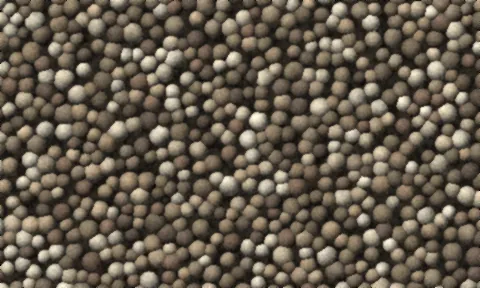
Pea gravel
- Size
- 3/8 in (10 mm)
- Shape
- Rounded, water-worn
- Colour
- Tan, brown, grey and white mixed
- Density
- 100 lb/ft³
Beds, paths, dog runs, drainage. Comfortable underfoot, will not lock together.
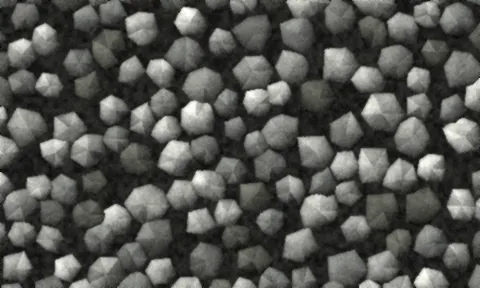
Crushed stone #57
- Size
- 3/4 in (20 mm)
- Shape
- Angular, no fines
- Colour
- Grey to blue-grey, or tan in limestone regions
- Density
- 104 lb/ft³
Driveway base, drainage, under patios. Locks together and drains freely.
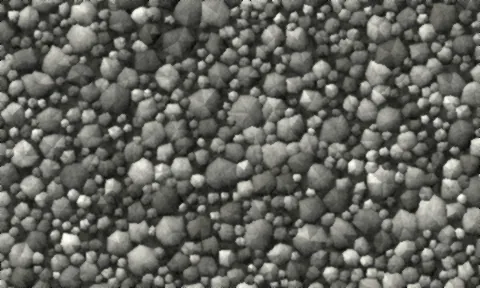
Crushed stone #411
- Size
- 3/4 in down to dust
- Shape
- Angular plus fines
- Colour
- Grey, darkening when damp
- Density
- 100 lb/ft³
Compacted driveway base. The fines fill the voids so it packs hard expect to lose 15–25% depth.
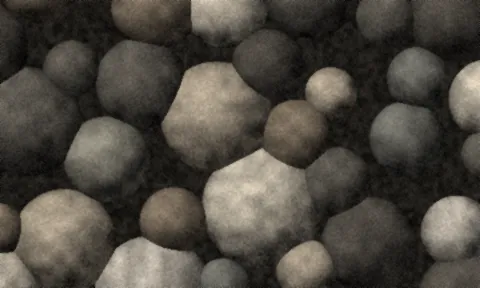
River rock
- Size
- 1–3 in (25–75 mm)
- Shape
- Rounded, water-worn
- Colour
- Mixed grey, brown, rust and cream
- Density
- 100 lb/ft³
Feature beds, dry creek beds, erosion control. Too large to walk on comfortably.
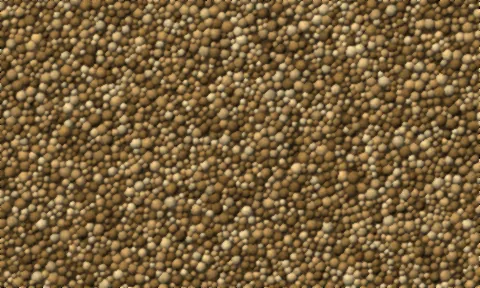
Decomposed granite
- Size
- 1/4 in down to dust
- Shape
- Angular fines
- Colour
- Warm gold, tan or rust depending on the quarry
- Density
- 104 lb/ft³
Paths and accessible routes. Compacts to a firm surface a stroller can cross.
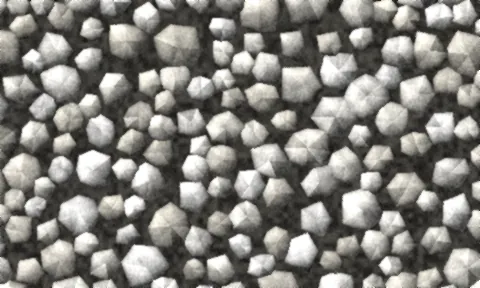
Marble chips
- Size
- 1/2–1 in (12–25 mm)
- Shape
- Angular, cleanly fractured
- Colour
- Bright white, sometimes green or pink veined
- Density
- 96 lb/ft³
Ornamental beds and borders where you want maximum brightness. Shows dirt.
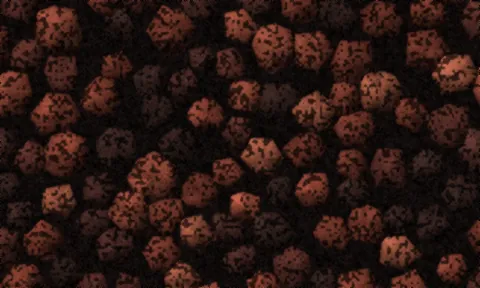
Lava rock
- Size
- 3/4–1 in (20–25 mm)
- Shape
- Angular and full of gas holes
- Colour
- Deep red-black or charcoal
- Density
- 52 lb/ft³
Mulch replacement and fire features. Roughly half the weight of gravel a yard is one pickup load, not two.
Questions
Frequently asked questions
For a 10x10 ft area at 2 inches deep, about 0.68 cubic yards roughly 0.92 US tons, or 37 bags with a 10% waste allowance included. At 3 inches it rises to about 1.02 cubic yards and 1.38 tons.
One US ton is about 20 cubic feet of pea gravel. That covers roughly 120 ft² at 2 inches, 80 ft² at 3 inches, or 60 ft² at 4 inches.
54 bags, either size. A cubic yard is 27 cubic feet, so it takes 54 half-cubic-foot bags. And because pea gravel runs about 100 lb per cubic foot, a 50 lb bag also holds about half a cubic foot so it is 54 fifty-pound bags too.
About 2,700 lb 1.35 US tons for dry washed pea gravel at 100 lb/ft³. Wet gravel carries roughly 8% more. Published figures range from 1.21 to 1.42 tons per cubic yard depending on stone type, moisture and settlement, which is why you should confirm with your supplier before buying by the ton.
4–6 inches over a compacted crushed stone base. Pea gravel is rounded and does not lock together, so without a base and firm edging it will rut under tyres and migrate off the edges. Use a 25% allowance for compaction.
Bulk is about four times cheaper per cubic yard, but carries a delivery fee. The crossover is around 0.4 cubic yards roughly 60 ft² at 2 inches. Below that, bags usually win. Above it, bulk wins on both cost and your back.
A 12x12 ft patio is 144 square feet. At the usual 3 inch patio depth that is about 1.47 cubic yards, roughly 1.98 US tons or 80 bags, with a 10% waste allowance included. At 2 inches it drops to about 0.98 cubic yards and 1.32 tons.
It can. The stones are rounded, so they migrate on any slope above about 5% and scatter without edging. Keep it on flat ground, edge it properly, and top up every few years as it settles into the soil.
For beds and paths, yes it stops the stone sinking into soft soil and slows weeds. For driveways, use a compacted crushed stone base with a woven geotextile beneath it instead; fabric alone will not carry the load.
Transparency
Sources and methodology
Every figure on this page comes from the assumptions below. Where a number is an average rather than a standard, it says so.
- Density — 100 lb/ft³ (1.35 US tons/yd³). Mid-range bulk density for rounded, water-worn gravel in the 3/8 inch size class. Published pea gravel densities span 1.21–1.42 tons/yd³; we use the middle and let you switch to wet. Background on aggregate production and classification: USGS Mineral Commodity Summaries 2026, Sand and Gravel (Construction) (PDF).
- Other material densities (loose, dry, lb/ft³): crushed stone #57 104 · crushed stone #411 100 · river rock 100 · decomposed granite 104 · marble chips 96 · lava rock 52. Each is a mid-range trade figure for loose material. Lava rock really is that light it is a vesicular volcanic aggregate specified at 35–55 lb/ft³, and landscape sites that list it near 100 lb/ft³ are wrong by roughly double. Note that #411 and decomposed granite are dense-graded and gain 15–25% when compacted, so order by loose volume and expect to lose depth.
- Wet uplift 8%. Applied when the material condition is set to wet. Saturated gravel can exceed this.
- Unit conversions. 27 ft³ per yd³; 1 ft = 12 in = 0.3048 m; 1 acre = 43,560 ft². All inputs are normalised to feet before any arithmetic.
- Bag sizes. 0.5 ft³ for bags sold by volume; 50 lb for bags sold by weight. Both work out to 54 per cubic yard at our density.
- Playground depths. Follow US Consumer Product Safety Commission playground surfacing guidance, which sets depth by equipment fall height: CPSC Public Playground Safety Handbook (Publication 325, PDF).
- Pricing. Indicative US ranges for comparison only. Aggregate pricing is intensely local always confirm with your own supplier.