Free · Preset for driveways
Pea Gravel Driveway Calculator
Preset to a 4 inch surface with a 25 percent compaction allowance, because a driveway settles into its base in a way a garden bed never does. Change any figure to match your own layout.
Quantity
How much pea gravel does a driveway need?
A driveway is measured the same way as any other area, length multiplied by width, multiplied by depth. What changes is the depth and the allowance. Beds and paths take 2 to 3 inches and a 10 percent waste margin. A driveway takes 4 to 6 inches and a 25 percent compaction allowance, because the surface is driven on and the stone works down into the base underneath it.
The figures below assume 4 inches of pea gravel at 100 lb per cubic foot, with that 25 percent allowance already included. One cubic yard covers 81 square feet at 4 inches, or 54 square feet at 6 inches. One US ton covers about 60 square feet at 4 inches.
| Driveway | Area | Depth | Cubic yards | US tons |
|---|---|---|---|---|
| Single car | 12 x 20 ft, 240 ft² | 4 in | 3.70 | 5.00 |
| Single car, deeper | 12 x 20 ft, 240 ft² | 6 in | 5.56 | 7.50 |
| Single car, longer | 12 x 24 ft, 288 ft² | 4 in | 4.44 | 6.00 |
| Two car | 24 x 20 ft, 480 ft² | 4 in | 7.41 | 10.00 |
| Two car, deeper | 24 x 20 ft, 480 ft² | 6 in | 11.11 | 15.00 |
Every figure above is the pea gravel you can see. It does not include the crushed stone base underneath, which is a similar volume again. A two car driveway needs roughly 7.4 cubic yards of pea gravel and another 11.1 cubic yards of base stone. Budget for both.
Depth
How deep should a pea gravel driveway be?
4 to 6 inches of pea gravel over a compacted base of 4 to 6 inches. That means excavating 8 to 10 inches below your finished grade so both layers fit without the driveway standing proud of the lawn.
Go shallower than 4 inches and the base shows through within a season. Go much deeper than 6 and it never feels firm, because loose rounded stone has nothing to brace against. Depth is not what makes a gravel driveway stable. The base is.
Why more pea gravel does not fix a rutting driveway
Pea gravel is rounded and water-worn. The stones roll over one another rather than locking together the way angular crushed stone does. Adding another two inches on top of a failing driveway gives you a deeper layer of stone that still rolls. The fix is always underneath, not on top.
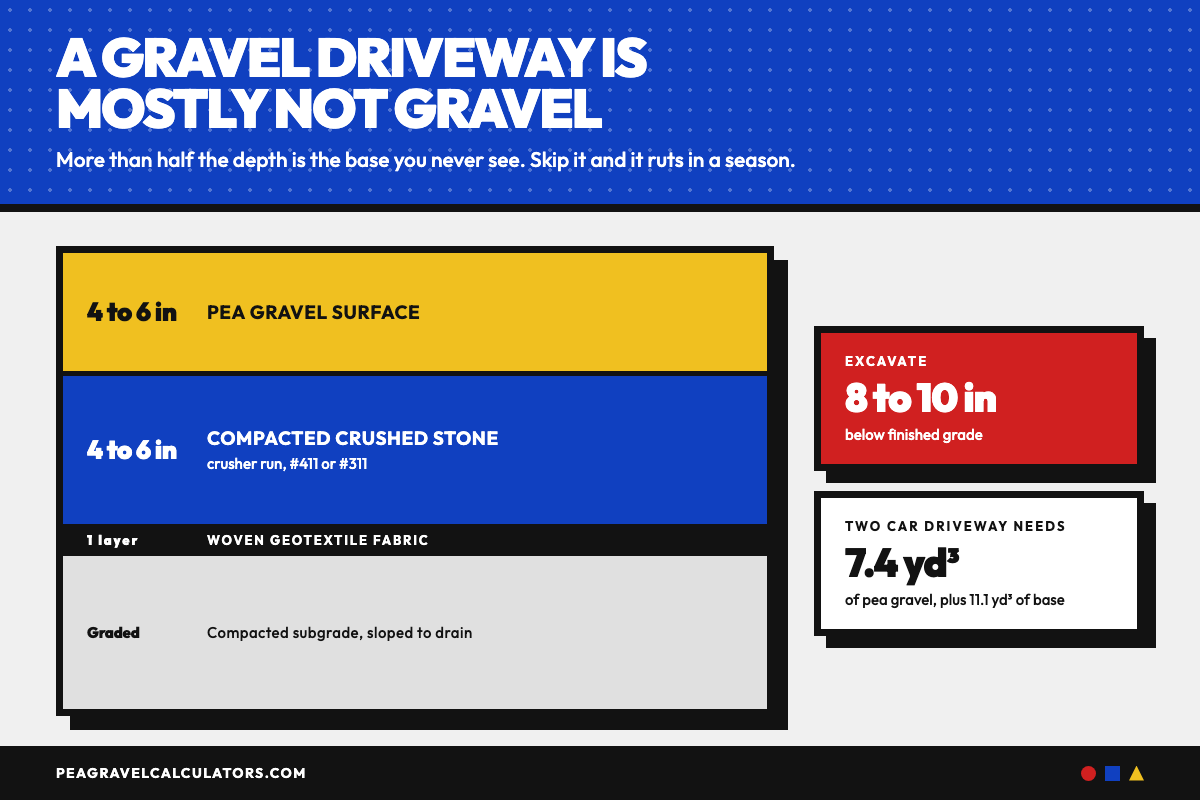
| Layer | Depth | Material |
|---|---|---|
| Subgrade | Compacted | Native soil, graded to fall |
| Separation | One layer | Woven geotextile fabric |
| Base | 4 to 6 in | Crusher run, #411 or #311, compacted |
| Surface | 4 to 6 in | Pea gravel |
| Total excavation | 8 to 10 in | Below finished grade |
Groundwork
What goes under a pea gravel driveway?
The layer nobody calculates, and the reason most gravel driveways fail.
Geotextile fabric
A woven separation fabric laid on the compacted subgrade. It stops the base stone punching down into soft soil, which is what creates potholes. Overlap seams by 12 inches. This is not the same as thin weed membrane, and it is there for separation rather than weeds.
Compacted crushed stone
4 to 6 inches of dense graded angular stone. Crusher run, #411 or #311 all work, because they contain fines that fill the voids and let the layer pack hard. Compact in 2 inch lifts with a plate compactor.
Edging
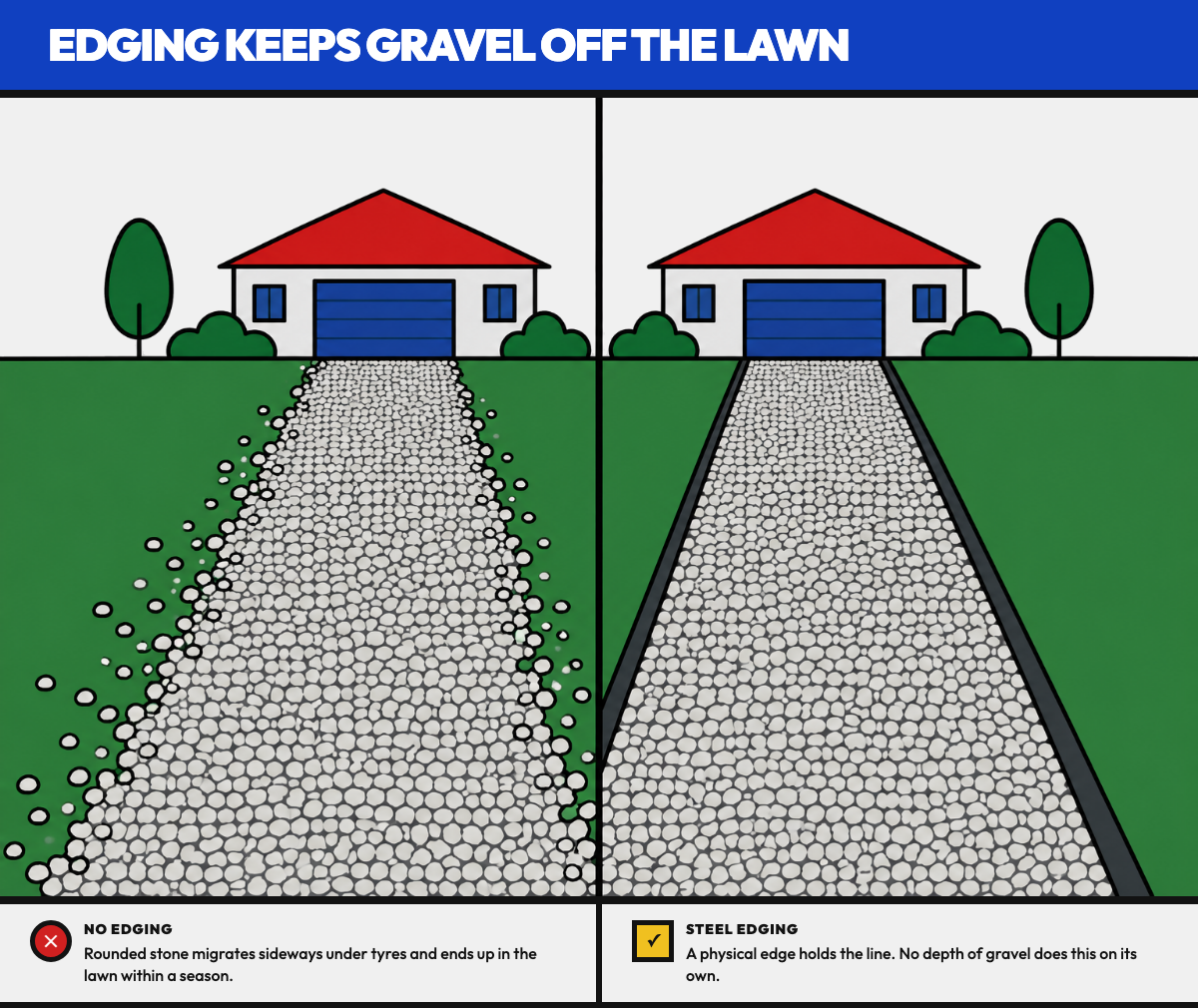
Steel, aluminum, stone or timber, standing proud of the finished level. Rounded stone migrates sideways under tires and there is no depth of gravel that prevents it. Only a physical edge does.
The base is where the load actually goes. Angular stone interlocks, so a compacted layer behaves almost like a slab and spreads the weight of a vehicle across the subgrade. Pea gravel cannot do this at any depth. It is a surface material sitting on top of the thing doing the work.
Base stone also compacts by 15 to 25 percent as it is rolled, so order loose volume accordingly. The crushed stone calculator sizes that layer and sets out which grade belongs where, and our material guide shows what each one looks like.
Durability
Will a pea gravel driveway wash away?
On flat ground with firm edging, no. On a slope, yes. Rounded stone rolls, and above roughly a 5 percent grade pea gravel migrates downhill with every heavy rainfall. That is a property of the stone shape, not a question of installation quality.
Four failure modes are worth planning around.
- Rutting. Tires push rounded stone aside and it does not spring back. Caused by a missing or under-compacted base.
- Migration. Stone travels sideways off the edges and downhill on any grade. Caused by missing edging or too much slope.
- Settlement. Surface stone works down into the base and the driveway loses visible depth. Normal, and the reason for topping up.
- Snow plough damage. A plough blade lifts loose gravel and throws it into the lawn. Raise the blade or use a rubber edge.
Tracking is the other complaint. Pea gravel is small enough to lodge in tire treads and shoe soles and end up indoors and in mowers. A band of paving or a hard threshold where the driveway meets a door largely solves it.
Cost
What does a pea gravel driveway cost?
Material is the small part. Bulk pea gravel runs roughly $30 to $65 per US ton delivered, so the 5 tons a single car driveway needs is about $150 to $325 in stone, plus delivery at roughly $10 to $25 per ton and often a minimum load. Add the base stone and you roughly double the material bill.
Installed, with excavation, fabric, base, compaction and edging, published figures put a single car driveway around $250 to $725 and a two car driveway around $400 to $1,450. Labour, not stone, is what moves that range.
| Item | Typical cost |
|---|---|
| Pea gravel, bulk delivered | $30 to $65 per ton |
| Crushed stone base | Similar per ton, larger volume |
| Delivery fee | $10 to $25 per ton |
| Steel edging | $2 to $6 per linear foot |
| Plastic edging | $0.50 to $3 per linear foot |
| Stone or brick border | $3 to $18 per linear foot |
| Geotextile fabric | $0.05 to $0.25 per sq ft |
Bagged gravel is not viable at driveway scale. A single car driveway at 4 inches is about 200 half cubic foot bags, which is 5 tons lifted twice by hand. Bulk delivery wins on cost past roughly 0.4 cubic yards, and on effort long before that. The bulk versus bagged comparison on the main page has the crossover maths, and the pea gravel cost guide prices delivery, installation and every extra.
Alternatives
How does pea gravel compare with asphalt, concrete and crushed stone?
| Surface | Locks together | Needs a base | Upkeep | Best for |
|---|---|---|---|---|
| Pea gravel | No | Yes | Top up every 2 to 4 years | Flat driveways, looks and drainage |
| Crushed stone #57 | Yes | Yes | Occasional grading | Load bearing, slopes |
| Crusher run or #411 | Yes, packs hard | Is the base | Low | The layer under everything |
| Asphalt | Bonded | Yes | Sealing, crack repair | Heavy use, slopes, snow country |
| Concrete | Bonded | Yes | Very low | Longest life, highest cost |
The honest summary is that pea gravel is the best looking and worst performing of the loose options. If the driveway is flat, edged and properly based, it is a good surface that drains freely and costs a fraction of asphalt. If any of those three things is missing, angular crushed stone will serve you better and cost about the same.
Upkeep
How do you maintain a pea gravel driveway?
Rake it level
Twice a year, pull stone back from the edges and fill the wheel tracks before they deepen into ruts.
Top up the depth
Every 2 to 4 years. Roughly one cubic yard per 80 square feet restores about an inch.
Check the edging
Edging that has sunk or bowed outward is why gravel is in the lawn. Reset it before adding more stone.
Treat weeds early
Fabric slows weeds, it does not stop seed landing on top. Pull them before roots reach the base.
Honest limits
When a pea gravel driveway is the wrong choice
Any slope above about 5%
The stone rolls downhill with rainfall. Angular crushed stone holds where pea gravel does not.
Over asphalt or concrete
Nothing for the stone to key into. It slides under tires and migrates off the edges.
Heavy or frequent traffic
Delivery lorries, trailers and daily turning movements rut a rounded surface faster than you can rake it.
Wheelchair or stroller access
Loose gravel is not a firm stable surface. Decomposed granite compacts hard and is the usual answer.
Questions
Pea gravel driveway FAQ
Four to six inches of pea gravel over a compacted crushed stone base of four to six inches. Excavate eight to ten inches below finished grade to fit both layers. Pea gravel alone at any depth will rut, because rounded stone does not interlock.
A single car driveway of about 240 square feet at four inches deep needs roughly 3.7 cubic yards, or 5 US tons, once a 25 percent compaction allowance is included. A two car driveway of about 480 square feet needs roughly 7.4 cubic yards, or 10 tons.
A woven geotextile separation fabric on the subgrade, then four to six inches of compacted angular crushed stone such as crusher run, #411 or #311. The fabric stops the base sinking into soft soil. The angular base carries the load that the pea gravel cannot.
On a flat driveway with firm edging, no. Above about a 5 percent grade it will migrate downhill with rainfall, because the stones are rounded and roll. On any real slope use angular crushed stone instead.
Yes. Without edging standing proud of the finished level, pea gravel spreads into the lawn and off the edges within a season. Steel edging runs about one to three dollars per linear foot, plastic about fifty cents to a dollar, and a stone or brick border three to eight dollars.
Expect to add material every two to four years. The surface loses depth to settlement into the base, to tracking on tires and shoes, and to snow clearing. Budget roughly one cubic yard per 80 square feet to restore an inch of depth.
Yes on installation, usually by a wide margin. Pea gravel materials run roughly one dollar per square foot, against several times that for asphalt. The gap narrows over time because gravel needs topping up and asphalt does not.
Over a sound compacted stone driveway, yes, at two to three inches. Over asphalt or concrete it is a poor idea. There is nothing for the stone to key into, so it slides underfoot and under tires and migrates off the edges.
Transparency
Sources and methodology
- Pea gravel density, 100 lb/ft³, 1.35 US tons per cubic yard. Mid-range bulk density for rounded water-worn gravel in the 3/8 inch size class. Background on aggregate production and classification, USGS Mineral Commodity Summaries 2026, Sand and Gravel (Construction) (PDF).
- Compaction allowance, 25 percent. Applied to driveway quantities because the surface settles into the base under traffic. Beds and paths use 10 percent.
- Base compaction, 15 to 25 percent. Dense graded material with fines loses that much volume when rolled, so order loose volume.
- Pricing. Indicative US ranges gathered from published cost guides for comparison only. Aggregate and labour pricing is intensely local. Always confirm with your own supplier and contractor.
- Unit conversions. 27 ft³ per cubic yard, 1 ft = 12 in = 0.3048 m. All inputs are normalised to feet before any arithmetic.
Working on something other than a driveway?
The main calculator covers beds, paths, patios, circles, L-shapes and seven materials.